The Hollywood AI Studio Boom: A Breaking Point for Film

Photo by Jake Blucker on Unsplash
Share this post:
The Hollywood AI Studio Boom: A Breaking Point for Film
The Hollywood Reporter used stark language in its recent cover story: Hollywood is approaching a "breaking point" as AI studios proliferate and venture capital floods in at an unprecedented rate. The number of AI studios blanketing Hollywood, along with the VC dollars to power them, is increasing at an astonishing rate, the trade wrote. Global funding for AI video generation companies reached $3.08 billion in 2025, a 94.6% increase over the $1.58 billion raised in 2024. The money is reshaping who controls the tools of production and, by extension, who controls storytelling itself.
This is not an abstract debate about the future. Runway closed a $315 million Series E round on February 10, 2026. Luma AI raised $900 million in late 2025. A new studio called Promise launched with backing from Peter Chernin and Andreessen Horowitz. The infrastructure for an AI driven entertainment industry is being built in real time, and Hollywood is wrestling with what it means for creative labor, intellectual property, and audiences.

Runway: From Video Generator to World Simulator
Runway, founded in 2018 in New York, has moved well beyond its origins as a text to video tool. The company closed a $315 million Series E on February 10, 2026, led again by General Atlantic, with participation from Nvidia, Adobe Ventures, AMD Ventures, Fidelity, and Felicis Ventures. The round nearly doubled its valuation to $5.3 billion, up from $3.3 billion at the time of its $308 million Series D the previous April. Total capital raised since inception now stands at $860 million.
The company has reframed its mission around what it calls "world models," generative systems designed to simulate complex physical and narrative environments rather than produce isolated video clips. Runway introduced its first world model in December 2025 and now considers the technology central to solving problems in medicine, climate research, robotics, and entertainment. For Hollywood, the pitch is that world models can generate synthetic production environments at scale.
Runway's tie to the established industry is not theoretical. In September 2024, the company announced a partnership with Lionsgate to develop a custom AI video generation model trained on the studio's proprietary catalog of more than 20,000 film and television titles. The model is designed exclusively for Lionsgate's use and focuses on pre and post production tasks. The deal is the clearest example of a major studio embedding an AI vendor directly into its production pipeline.

Luma AI: Saudi Billions and the First AI Movie
Luma AI raised $900 million in a Series C round in November 2025, led by Humain, Saudi Arabia's state backed AI company. The round also included AMD's venture arm, as well as existing investors Andreessen Horowitz, Amplify Partners, and Matrix Partners. The deal valued Luma at approximately $4 billion and came with a separate infrastructure agreement to build a 2 gigawatt AI computing cluster in Saudi Arabia, dubbed Project Halo.
The company's CEO, Amit Jain, has stated publicly that the first movie "significantly aided by AI" will arrive in 2026, though he has been careful to frame it as short form or mid form content rather than a feature film. That distinction matters. The industry has not yet seen a theatrically released film where AI did the heavy creative lifting, and audience reception to such a project remains untested.
Luma's Dream Machine platform already serves a broad base of creative users. In September 2025, the company released Ray3, described as a reasoning video model capable of interpreting complex prompts across video, images, and audio. In benchmark comparisons, Ray3 performed above OpenAI Sora 2 and around the same level as Google Veo 3 at the time of release. The company is positioning itself less as a production tool and more as a foundational model provider with Hollywood as one of several target markets.
Promise: A New Studio Built Around Generative AI
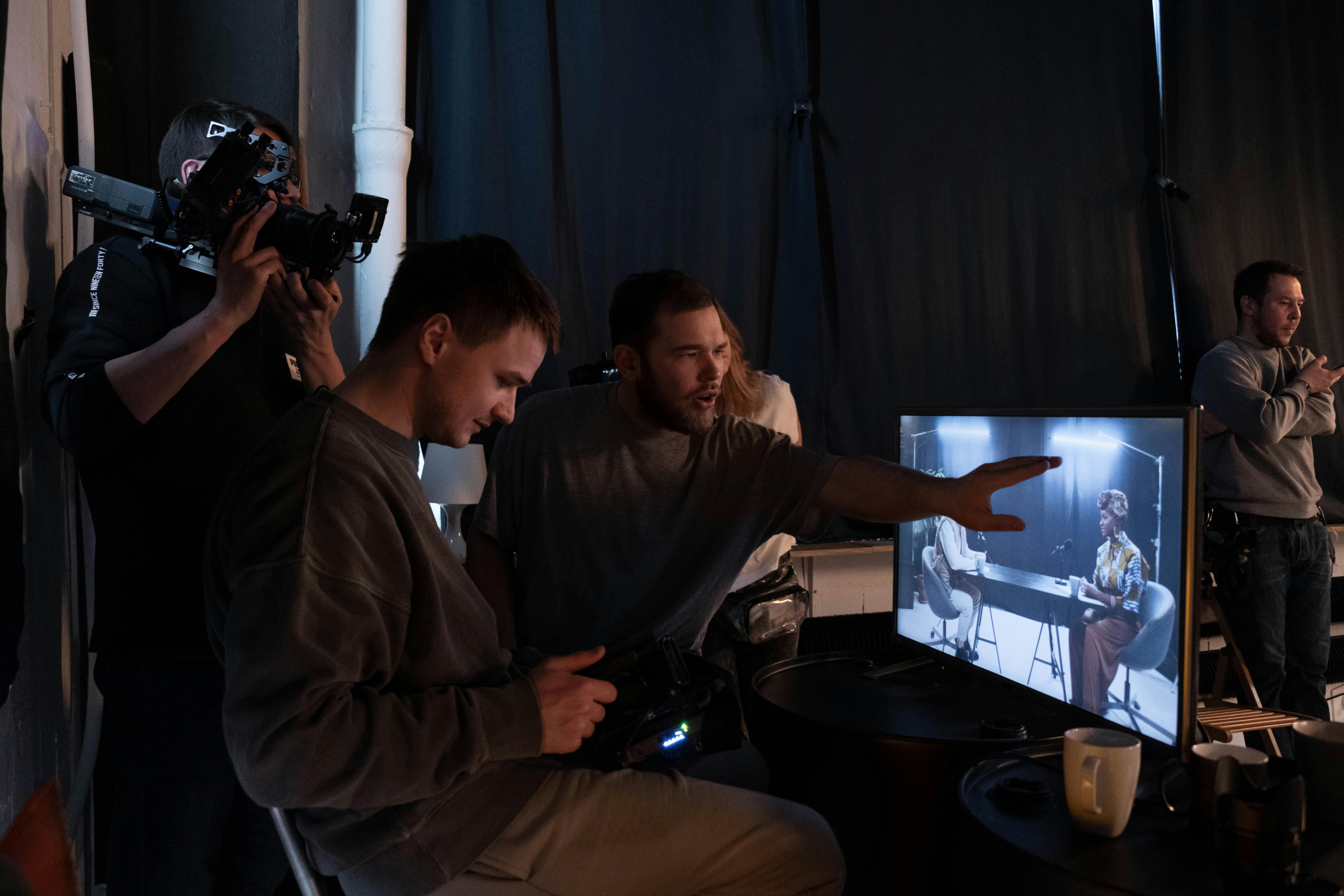
The most direct bet on the AI native studio model came in late 2024 with the launch of Promise Advanced Imagination. The studio was founded by George Strompolos, former CEO of Fullscreen, alongside Jamie Byrne, formerly of YouTube's creator partnerships team, and filmmaker Dave Clark, who serves as chief creative officer. The initial seed round was led by Peter Chernin's North Road Company and Andreessen Horowitz's Andrew Chen, with a subsequent strategic investment from Google's AI Futures Fund and Michael Ovitz's Crossbeam Venture Partners.
Promise is not building tools. It is building an entertainment company that uses generative AI as its production backbone. The studio has developed its own internal software platform called MUSE, which integrates AI tools across the entire production chain from development to post. It is actively working on a multi year slate of films and series aimed at a range of distribution platforms.
The backing is notable. Chernin built and sold Fox Interactive Media and ran News Corp's entertainment businesses before founding his own media company. Andreessen Horowitz is among the most influential technology investors in the world. Both have made a specific bet that generative AI can support the creation of narrative entertainment at a quality level that audiences will accept.
Labor, IP, and the Power Struggle
The Hollywood Reporter framed its analysis around a power struggle between cost cutting, IP ownership, and labor protections. All three tensions are visible in the current landscape.
On IP, Runway's Lionsgate model sits at the center of ongoing debate. Critics in the creative community have questioned why major studios partner with AI companies that have faced allegations of training on unlicensed data. The studios' answer, implicit in these deals, is that custom models trained on proprietary content sidestep that problem. Whether that argument holds legally and ethically remains contested.
On labor, SAG-AFTRA has not been passive. When Seedance 2.0 released a video generation tool that spread a realistic deepfake of a Brad Pitt and Tom Cruise fight scene, the union threatened action. The model's parent company agreed to implement guardrails after that confrontation. The incident illustrated how quickly AI video tools can create content that directly challenges existing performer protections and guild authority.
The cost cutting dimension is the most straightforward. Studios are under sustained pressure to reduce budgets, and AI offers genuine efficiency gains in VFX, storyboarding, voice work, and post production. The Hollywood Reporter noted that the main audience for these AI moves sometimes appears to be Wall Street rather than end users. Whether those efficiency gains ultimately benefit productions, studios, investors, or workers depends on contract structures that are still being negotiated.

Audience Skepticism Remains Unresolved
The THR piece pointed to a persistent and underexamined question: audiences have not yet demonstrated enthusiasm for content they know was created primarily by AI. Early AI generated content that spread on social media drew ridicule as much as admiration. Box office performance of films that have disclosed heavy AI involvement has not been tracked in a meaningful comparative way because so few have done so.
This creates a structural problem for the VC thesis behind companies like Runway, Luma, and Promise. The assumption is that AI generated entertainment will find a large audience. The evidence for that assumption is thin. It may be that audiences simply do not care how content is made if the story and production quality meet their expectations. It may also be that disclosure of AI involvement creates a perceptual barrier that lowers audience willingness to engage. No one has a reliable answer.
Reuters reported in February 2026 on dedicated AI film schools now training the next generation of creators specifically in generative production workflows. These programs are producing graduates who see AI as their native toolkit rather than a supplement to traditional skills. That generational shift may resolve the audience question over time as creators who grew up with AI tools develop a more intuitive sense of what works.
What This Means for Working Filmmakers
The concentration of capital in a handful of AI video companies has real implications for independent creators. Runway, Luma, and their competitors are competing intensely for users, which drives feature development and often suppresses subscription prices in the short term. Filmmakers who integrate these tools into their practice now are building skills on platforms that are simultaneously becoming more capable and more affordable.
The AI on the Lot conference in Culver City, returning May 27-28, is where these companies, studios, and filmmakers converge in person each year. Luma AI, NVIDIA, Paramount, and others from this same funding wave have all been past sponsors.
The studio level deals. Lionsgate partnering with Runway, Promise developing studio partnerships, Luma targeting entertainment and advertising. signal where production workflows are heading. Independent filmmakers who understand how these tools work will be better positioned to collaborate with productions that expect fluency with them. The Lionsgate partnership, for instance, is part of a broader studio push covered in our piece on Lionsgate's AI initiatives at CES 2026.
The labor and IP questions are not resolved, but the direction of travel is clear. Negotiated frameworks will govern how AI tools are used in union productions. Understanding those frameworks, as they develop through SAG-AFTRA and guild negotiations in 2026, is as important as understanding the technical capabilities of the tools themselves. Veteran producers and directors are now arguing the industry should stop playing defense and instead adopt a proactive AI strategy that channels this capital toward creative leadership rather than pure cost reduction.
Sources
The Hollywood Reporter: "Hollywood's AI Breaking Point May Be Nearing" https://www.hollywoodreporter.com/business/business-news/hollywood-ai-breaking-point-1236512451/
TechCrunch: "AI video startup Runway raises $315M at $5.3B valuation, eyes more capable world models" (February 10, 2026) https://techcrunch.com/2026/02/10/ai-video-startup-runway-raises-315m-at-5-3b-valuation-eyes-more-capable-world-models/
Deadline: "Runway Raises $308M In Series D Funding Said To Value The AI Firm At $3B" (April 2025) https://deadline.com/2025/04/ai-firm-runway-raises-308-million-series-d-funding-3-billion-valuation-1236358416/
Variety: "Lionsgate Inks Deal Runway Partners to Use Gen AI for Filmmakers" (September 2024) https://variety.com/2024/digital/news/lionsgate-generative-ai-filmmakers-runway-1236148854/
The Wrap: "First AI Movie Is Coming in 2026, Luma AI CEO Says" https://www.thewrap.com/luma-ai-first-movie-2026-saudi-investment/
CNBC: "Luma AI raises $900 million in funding round led by Saudi AI firm Humain" (November 2025) https://www.cnbc.com/2025/11/19/luma-ai-raises-900-million-in-funding-led-by-saudi-ai-firm-humain.html
Variety: "Promise, a Generative AI Studio Startup, Raises Seed Funding From Peter Chernin, Andreessen Horowitz" (2024) https://variety.com/2024/digital/news/promise-gen-ai-studio-funding-peter-chernin-andreessen-horowitz-1236214333/
Reuters: "AI film school trains next generation of Hollywood moviemakers" (February 14, 2026) https://www.reuters.com/business/media-telecom/ai-film-school-trains-next-generation-hollywood-moviemakers-2026-02-14/
Continue Reading

Video & LipSync
- Video Generator
- Text to Video
- Image to Video
- Start-End Frame to Video
- Draw to Video
- Motion Control
- Video Enhancer
- Video Upscaler
- Video to Video LipSync
- Audio to Video LipSync
- Image to Video LipSync
- Video FaceSwap
- Seedance 2
- OpenAI Sora 2
- Kling 3.0
- Kling O1
- Google Veo 3.1
- LTX 2.3
- Kling O1
- Hailuo AI
- Luma Ray
- Kling 3.0 Motion
- Topaz Upscaler
- InfiniteTalk Face Swap